Collected broadside · six-study version
The Fixed Point
This collected broadside names six studies and adds The Engine to its colophon. The separately preserved original PDF names five studies and has a different layout. Both versions remain available.
The recovered collected file is a ZIP containing page images and OCR text, despite its historical .pdf filename. This reader displays the embedded images unchanged, with their OCR available below each page.
Page 1
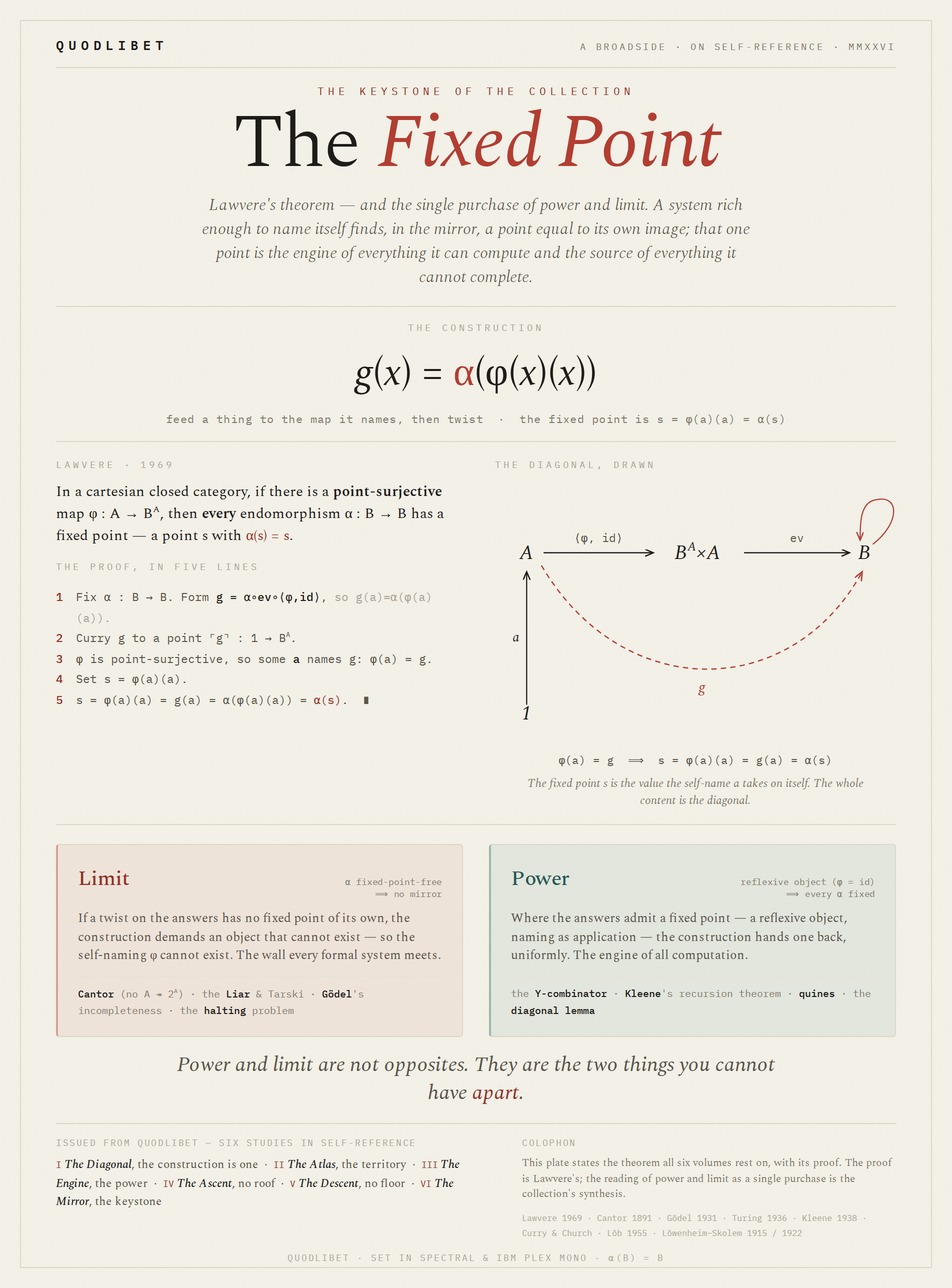
OCR text · page 1
Q U O D L I B E T A B R O A D S I D E · O N S E L F - R E F E R E N C E · M M X X V I
T H E K E Y S T O N E O F T H E C O L L E C T I O N
The Fixed Point
Lawvere's theorem — and the single purchase of power and limit. A system rich
enough to name itself finds, in the mirror, a point equal to its own image; that one
point is the engine of everything it can compute and the source of everything it
cannot complete.
T H E C O N S T R U C T I O N
g(x) = α(φ(x)(x))
feed a thing to the map it names, then twist · the fixed point is s = φ(a)(a) = α(s)
LAWVERE · 1969
In a cartesian closed category, if there is a point-surjective map φ : A →
Bᴬ, then every endomorphism α : B → B has a fixed point — a point s
with α(s) = s.
THE PROOF, IN FIVE LINES
1 Fix α : B → B. Form g = α∘ev∘⟨φ,id⟩, so g(a) = α(φ(a)(a)).
2 Curry g to a point ⌜g⌝ : 1 → Bᴬ.
3 φ is point-surjective, so some a names g: φ(a) = g.
4 Set s = φ(a)(a).
5 s = φ(a)(a) = g(a) = α(φ(a)(a)) = α(s). ∎
THE DIAGONAL, DRAWN
A B
A
×A B
⟨φ, id⟩ ev
α
g
1
a
φ(a) = g ⟹ s = φ(a)(a) = g(a) = α(s)
The fixed point s is the value the self-name a takes on itself. The whole content is the diagonal.
Limit α fixed-point-free ⟹ no mirror
If a twist on the answers has no fixed point of its own, the construction demands
an object that cannot exist — so the self-naming φ cannot exist. The wall every
formal system meets.
Cantor (no A ↠ 2ᴬ) · the Liar & Tarski · Gödel's incompleteness · the halting
problem
Power reflexive object (φ = id) ⟹ every α fixed
Where the answers admit a fixed point — a reflexive object, naming as application
— the construction hands one back, uniformly. The engine of all computation.
the Y-combinator · Kleene's recursion theorem · quines · the diagonal lemma
Power and limit are not opposites. They
are the two things you cannot have apart.
ISSUED FROM QUODLIBET — SIX STUDIES IN SELF-REFERENCE
I The Diagonal, the construction is one  ·  II The Atlas, the territory  ·  III The Engine, the power  ·  IV The Ascent, no roof  ·  V The Descent, no floor  ·  VI
The Mirror, the keystone
COLOPHON
This plate states the theorem all six volumes rest on, with its proof. The proof is Lawvere's;
the reading of power and limit as a single purchase is the collection's synthesis.
Lawvere 1969 · Cantor 1891 · Gödel 1931 · Turing 1936 · Kleene 1938 · Curry &
Church · Löb 1955 · Löwenheim–Skolem 1915 / 1922
Q U O D L I B E T · S E T I N S P E C T R A L & I B M P L E X M O N O · Α ( B ) = B
Download the unchanged OCR text